
All services Every engagement has a fixed, published price. Book a strategy call
The EU AI Act deadlines changed in June 2026, and only half of them moved. This checklist is current to the Act as amended: what still lands on 2 August 2026, what moved to 2027 and 2028, and the ten steps that get a CIO or CISO defensibly ready.


The EU AI Act readiness checklist below is written for CIOs and CISOs who need a concrete plan rather than legal theory. The EU Artificial Intelligence Act is now in force. It is the first full legal framework for AI systems, with a risk-based model, heavy obligations for high-risk AI, and significant fines for non-compliance. For technology and security leaders, this is now a core architecture, data and risk issue – not a side legal topic.
For CIOs and CISOs, the message is simple: you cannot treat the EU AI Act as a legal side issue. It sits in the middle of your architecture, data, security and operating model. If you wait for the 2027 high-risk deadline, you will be retrofitting governance into live AI systems under pressure, while the 2026 transparency duties land on top of you.
It focuses on the steps that you and your teams can control:
Building a complete view of your AI systems
Understanding where the EU AI Act applies
Classifying risk and obligations
Identifying gaps in architecture, controls and governance
Building a realistic roadmap from now to 2028
If you work through this checklist honestly, you will know whether you can handle EU AI Act readiness internally, or whether you need a structured EU AI Act Readiness Assessment to move faster and reduce risk.
The EU AI Act deadlines changed in June 2026, and only half of them moved. The Digital Omnibus, given final approval by the Council on 29 June 2026, postponed the high-risk obligations: stand-alone Annex III systems now comply from 2 December 2027, and high-risk AI embedded in regulated products from 2 August 2028. Everything else stands: the bans on prohibited AI and the AI literacy duty have applied since February 2025, general-purpose AI obligations since August 2025, transparency duties apply from 2 August 2026, and AI generated content must be marked from 2 December 2026.
That means the most dangerous sentence in AI compliance right now is “the EU AI Act got delayed”. If your business runs customer chatbots, generates content with AI, or uses AI that people interact with, your next deadline is 2 August 2026 rather than 2027. And the 2027 date is one procurement cycle away for any system that needs architecture change.
| Date | What applies | Who feels it first |
|---|---|---|
| Since 2 February 2025 | Bans on prohibited AI practices, and the AI literacy duty | Everyone: the bans are enforceable now |
| Since 2 August 2025 | Obligations for general-purpose AI models | Model providers, and those building on them |
| 2 August 2026 | Article 50 transparency: telling people they are interacting with AI, disclosing deepfakes | Anyone running customer chatbots or AI that people interact with |
| 2 December 2026 | Marking of AI generated content | Anyone publishing AI generated text, image, audio or video at scale |
| 2 December 2027 | High-risk obligations for stand-alone Annex III systems (moved from August 2026 by the Omnibus) | Employment, credit, education, essential services, law enforcement uses |
| 2 August 2028 | High-risk AI embedded in regulated products (moved from 2027) | Manufacturers and their supply chains |
Sources: the amended implementation timeline following the Digital Omnibus, adopted by the European Parliament on 16 June 2026 and the Council on 29 June 2026. This article was reviewed after those changes, which is worth checking on any EU AI Act guidance you read: most of what ranks today was written before them.
When the high-risk postponement was agreed, headlines said the EU AI Act had been delayed. Half true, and the wrong half to relax about.
What did not move: the prohibitions have been enforceable since February 2025, with the largest fines in the Act attached. General-purpose AI duties have applied since August 2025. And on 2 August 2026, Article 50 transparency arrives: people must be told when they are interacting with an AI system, and deepfakes must be disclosed. On 2 December 2026, AI generated content must be identifiable as such. If your business runs chatbots, AI assistants, or publishes AI generated material, those are your deadlines, and they are weeks away rather than years.
Why 2027 is closer than it sounds: the Annex III high-risk obligations now apply from 2 December 2027. For a CIO or CISO, that is one budget cycle and one procurement cycle. High-risk compliance is not a policy exercise: it needs logging you can replay, documentation that matches reality, human oversight that genuinely works, and data governance underneath all of it. Systems that need architectural change to meet those duties need that change starting now, because the alternative is paying emergency prices in eighteen months.
The practical reading: use the postponement as a gift of sequencing rather than a reason to stop. Fix the 2026 transparency duties immediately, and use the bought time to do the high-risk work properly instead of in a panic.

Before you follow a detailed EU AI Act readiness checklist, you need to confirm whether you are in scope and in what role.
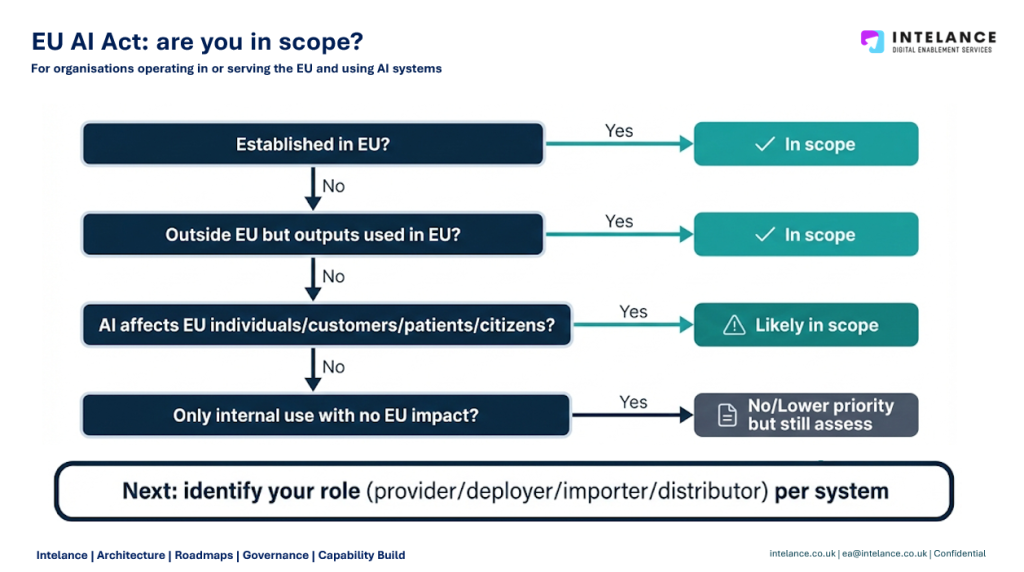
You are very likely in scope if:
The EU AI Act defines several operator roles, including:

In practice, many enterprises are:
Your EU AI Act readiness plan must be clear about which role you play for each AI system, because obligations differ for providers and deployers.
This is the core of the article. Use it as a working document with your teams.
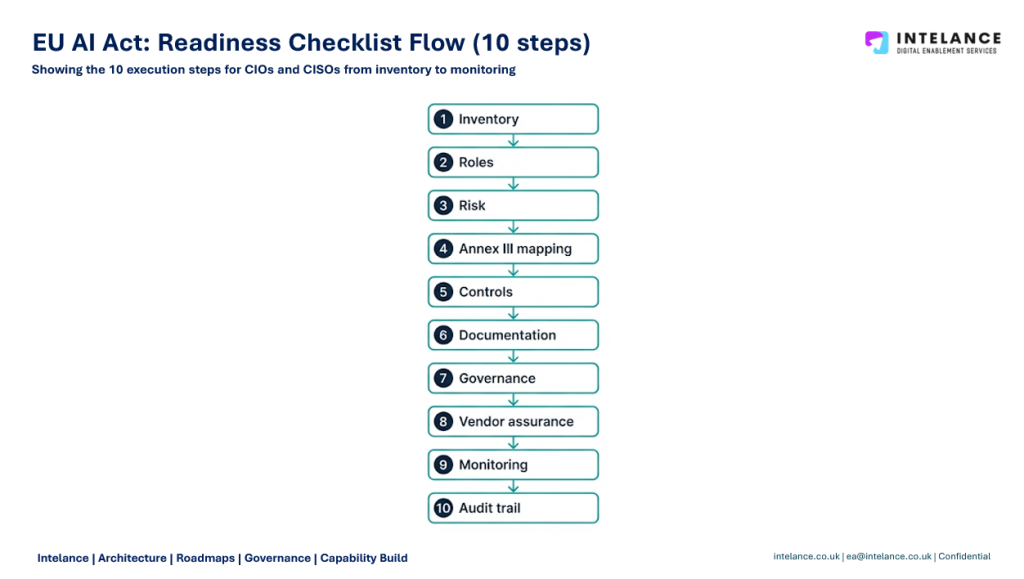
You cannot manage what you cannot see.
Tasks:

Output: a living AI System Inventory, owned jointly by technology and risk. This is the first anchor for every EU AI Act readiness checklist and every EU AI governance discussion.
For each AI system in your inventory:
This gives you:
The EU AI Act uses a risk-based model:

For each AI system in your inventory:
Output: a risk classification for each system: prohibited, high risk, limited risk, minimal risk.
High-risk AI systems are subject to a long list of requirements covering:
Your checklist here:
For CIOs and CISOs, most of the real work will fall under data and logging.
Check, for each high-risk AI system:
You will quickly see which systems are easy to bring into line and which will need serious work or redesign.
The EU AI Act expects that high-risk systems do not run unchecked. There must be meaningful human oversight that can prevent or correct harmful outcomes.
Checklist questions:
As a CIO or CISO, you do not need to design the detailed workflows, but you must ensure that oversight is real, auditable and backed by systems and training.
The EU AI Act does not replace security and incident management. It builds on them.
You should:
Use MITRE ATLAS to structure AI threat modelling with real-world attacker techniques.
Attach AI risks to existing governance forums and risk registers. You want one coherent picture of operational risk rather than a separate AI risk world.
UK organisations can also align to the UK Government’s AI Cyber Security Code of Practice.
Policies and checklists mean very little without a clear operating model.
At a minimum, you need:
This should align with your broader governance and, where relevant, with ISO 42001 (AI management systems) so that AI Act compliance is embedded into normal governance rather than run as a side project.
For a deeper dive into AI operating models and ISO 42001, see our AI Strategy & Operating Model Consulting service.
Once you have:
You can turn EU AI Act readiness into a roadmap.
Organise work into three waves:
This roadmap should be costed and linked to your technology and security budgets. If it is not funded, it will not happen.
You do not need to outsource everything. You should own your AI strategy, architecture, risk appetite and culture.
However, it is usually efficient to bring in specialists for:
If you have a small internal team, or if you are already stretched by security, cloud and data programmes, this is the point where you decide whether you will move slowly and reactively, or whether you will front-load the work and remove EU AI Act readiness as a strategic risk.
If you want a structured, time-boxed engagement, see our EU AI Act Readiness Assessment
From an architecture and security perspective, the common failure patterns are clear:
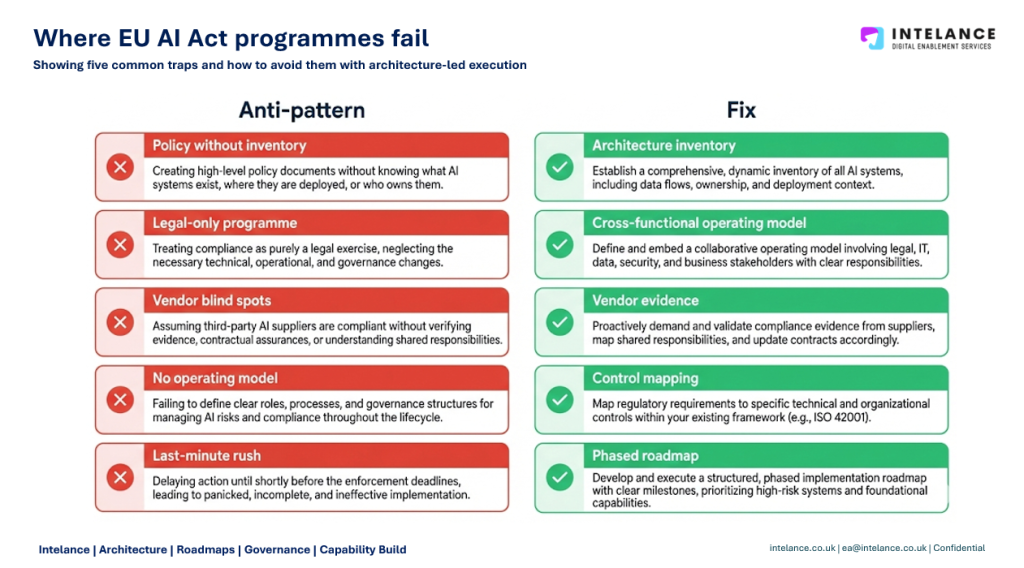
You avoid these traps by:
We see the same patterns in our enterprise architecture consulting work across pharma, manufacturing and public sector organisations.
Everything above is work we do for clients, at fixed published fees, current to the Act as amended in June 2026:
As a CIO or CISO, this gives you something concrete to take to the board: a defensible view of where you stand against the amended dates, what it costs to close the gaps, and evidence that the 2026 duties are handled before anyone official asks.
Partially. The Digital Omnibus, adopted in June 2026, moved high-risk obligations for stand-alone Annex III systems to 2 December 2027 and for AI embedded in regulated products to 2 August 2028. It did not move the prohibitions and AI literacy duty, in force since February 2025, the general-purpose AI obligations, in force since August 2025, the Article 50 transparency duties arriving 2 August 2026, or the AI content marking duty arriving 2 December 2026.
Article 50 transparency: people must be told when they are interacting with an AI system, and deepfakes must be disclosed. If you run customer chatbots or AI that people interact with, this date is yours regardless of the high-risk postponement. AI generated content marking follows on 2 December 2026.
A structured list of actions that maps every AI system you run, confirms whether you are in scope, classifies each system against the Act as amended, and identifies the gaps in architecture, controls and governance. It turns the EU AI Act into a concrete plan your architecture, security, risk and legal teams can execute together, sequenced against the real dates.
Not legal alone. Ownership usually sits with a senior technology or risk leader, supported by architecture, security, data, risk, compliance and legal, because the hard work is in systems rather than documents. One executive must be accountable for the roadmap and the outcomes.
A defensible readiness position takes four to six weeks: inventory, classification, role determination and a gap roadmap. Closing the gaps depends on what the roadmap finds: transparency fixes for the 2026 dates are usually quick, while high-risk systems needing architectural change can consume much of the runway to December 2027, which is why the postponement is sequencing time rather than spare time.
Strong GDPR and security programmes help enormously, and the smart route is to extend them rather than duplicate them. But the Act adds duties they do not cover: system classification, transparency to users, model documentation, human oversight and lifecycle controls. You still need an explicit plan against the Act as amended.
Up to €35 million or 7 per cent of global annual turnover for prohibited practices, and up to €15 million or 3 per cent for most other breaches, with proportionate caps for smaller companies. The prohibited practice rules have applied since February 2025, so the largest penalty tier is already live.
Keep strategy, risk appetite and decisions in-house. External support earns its fee on the system-level work: building the inventory honestly, classifying against the amended Act, and placing controls in real architecture. Our EU AI Act Readiness Assessment does exactly that in four to six weeks from £18,000 + VAT, fixed after a scoping call, with every price published.

Emmanuel Olatunji
Chief Enterprise Architecture Partner
Emmanuel founded Intelance in 2017 and has led architecture, AI governance, cyber and deal engagements across the UK, Europe, the Middle East and Africa. Every Intelance engagement runs under his direction, and every guide he publishes comes from that work.
See his record on LinkedIn About IntelanceThirty minutes with the adviser who wrote this guide. A clear view of your exposure, the sensible first step and its published fee.
Talk to a senior adviser AI Governance
 AI Governance
